"Mama, where's the Rx from September?"
The paper ended up in a drawer with three years of bills, photos, lab reports. Nobody filed it. Nobody knew it would matter today.
Every prescription, every reminder, every doctor — neatly synced to one app. For you, and for the people you care for.
Most chronic patients in India navigate a paper-and-memory system. Every missed dose, every lost prescription, every doctor visit that starts from zero — the small frictions add up to a hospital admission five years from now.
The paper ended up in a drawer with three years of bills, photos, lab reports. Nobody filed it. Nobody knew it would matter today.
No alarm. No reminder. He says "I think I did" but he's not sure. You're not sure. The pill bottle looks the same as it did yesterday.
She rings every evening. "Mama, did you eat? Did you take the pill?" Mum says yes. Sometimes she means no. Sometimes she's confused.
She brings a plastic bag of pill bottles to every visit. The cardiologist asks. The endocrinologist asks. The GP asks. Each one writes their own note in their own file.
Same family. Same chemist. Same doctors. AICA is the quiet thread between them — so the small frictions stop adding up against you.
Most of AICA — medical history, dose alarms, refills, dependents — is free for every patient, forever. Three daily-wellness features sit behind a small Pro tier, because they need real AI compute and a continuous care loop with your doctor and caregivers.
A daily journal — mood, pain, sleep, voice notes — that becomes a 30-day pattern your doctor and the people who care for you can see at the same time, the moment you press save.
An AI that asks one short question, listens to the answer (in Hindi or English), and quietly builds a living health record. Vitals, symptoms, adherence — all on a daily timeline that your doctor and your caregiver see at the same time you do.
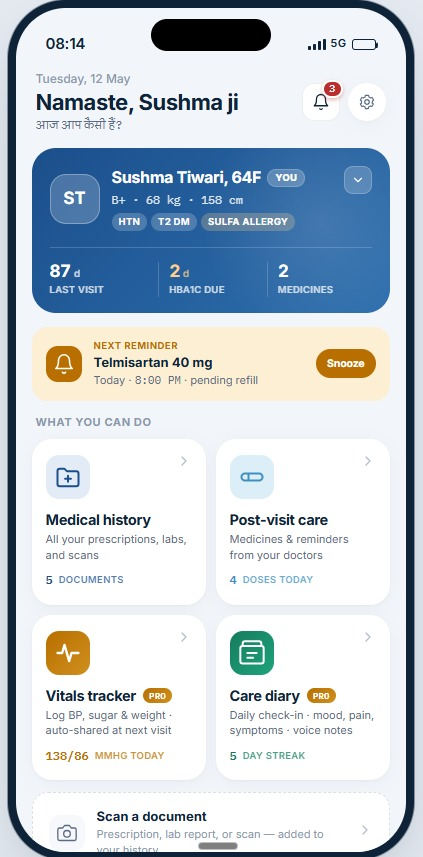
BP, sugar, weight — logged in 10 seconds, auto-shared with your care team. AICA's AI spots the drift before you do, and your file at the next visit is already up to date.
Not a hospital portal. Not a paid health record. A genuinely small, calm app that earns its place on a 64-year-old's home screen.
Pharmacy scans the paper Rx, AICA reads the handwriting, you receive a WhatsApp link. Tap once and your alarms set themselves up. No typing.
Per-medicine times, schedule rules ("after food," "with milk"), one-tap mark-as-taken. Tonight's pending dose stays bright until you confirm.
Manage Mum, Dad, kids and yourself from one phone. Claim a prescription "on behalf" and AICA creates a dependent profile. Switch in one tap.
Every prescription, every consult, every lab report stitched together in chronological order. Show the next doctor your full story in 5 seconds.
Tell AICA your symptoms while you're in the waiting room. The doctor opens your room already knowing the story — you skip the intake.
Search and connect to AICA-verified clinicians. Letterhead checks, MCI registry cross-check, and patient corroboration before a doctor shows up in your search.
From walking out of Dr. Mehrotra's clinic to her morning Telmisartan alarm two weeks later. Five steps. No paperwork.
BP medicines, follow-up in 3 months. Sushma gets a paper print.
Anil ji types Sushma's daughter's number. AICA reads the Rx, sends a WhatsApp link.
Installs AICA, claims the Rx "on behalf of Mum." Mum's profile is created automatically.
Mum confirms with one tap. Priya sees the green check on her phone. Adherence stays on track.
WhatsApp reminder lands at the chemist. Mum picks up before she runs out. The loop closes.
Numbers below are illustrative early-stage targets across pilot clinics — the platform is engineered to deliver these as primary KPIs.
Mum used to forget her BP pill three times a week. Since AICA, she's not missed one in two months — and I see it from Delhi.